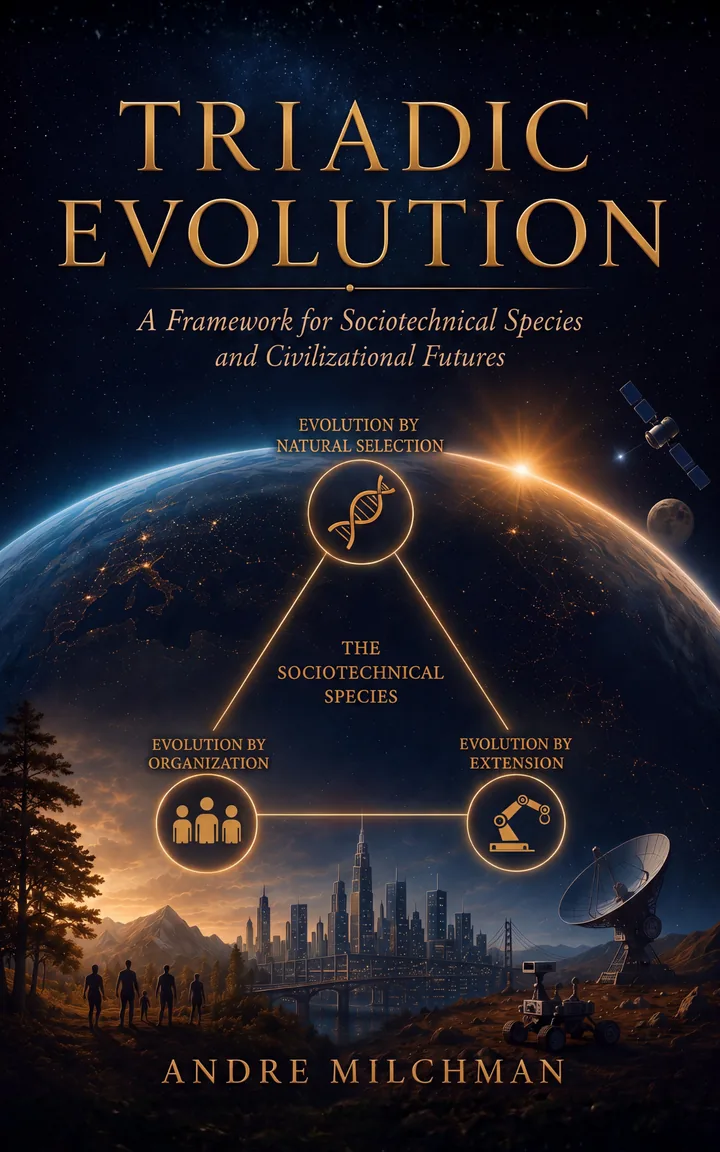
Cover of Triadic Evolution by Andre Milchman
A scientific manifesto and conceptual architecture

Triadic Evolution

A Framework for Sociotechnical Species and Civilizational Futures
Andre Milchman

Humanity remains biological, but human adaptation also proceeds through social organization and through the physical and digital extensions that enlarge what people and institutions can do. Triadic Evolution brings these domains into one framework for understanding how sociotechnical species change—and how expanding capability can remain connected to authority, responsibility, and correction.

Amazon ASIN: B0HDFDVQGT
The central proposition

One sociotechnical species. Three interacting strands of evolution.

Triadic Evolution does not replace evolutionary biology. It enlarges the object of inquiry to include the biological organism, social organization, and capability-bearing extensions—while preserving the distinct mechanisms through which each changes.

1

Evolution by Natural Selection

Biological organisms and populations continue to change through inherited variation, differential survival and reproduction, genetic drift, gene flow, and related processes. Human technology changes the conditions of selection; it does not make biology obsolete.

2

Evolution by Organization

Social organization changes through relations, roles, authority, institutions, culture, routines, collective memory, and learning. Organization mediates between experience and collective response, and increasingly governs the use of powerful extensions.

3

Evolution by Extension

Physical and digital extensions enlarge reach, speed, force, memory, precision, communication, and computational capacity. Tools, infrastructures, software, automation, and AI change the practical capabilities through which biological and social actors operate.

The architecture

Three questions organize the framework.

The book separates processes, domains of activity, and forms of order so that each answers a different architectural question.

What evolves?
Three evolutionary strandsNatural selection, organization, and extension.
Where does activity occur?
Three realmsSocial, physical, and digital—associated primarily with relating, making, and computing.
How are actors ordered?
Three sociotechnical ordersEcosystemic order through coexistence, conditioned order through regulation, and systemic order through integration.
Who acts?
Two responsibility-bearing primitivesSociotechnical agents and sociotechnical units, each acting through a social core and technological periphery.
Extension expands capability; organization governs capability.
What the book examines

From evolutionary architecture to the governance of increasingly capable technologies.

The argument moves from what a sociotechnical species is to the responsibility architecture needed when capability moves outward through technological extensions.

The sociotechnical speciesWhy human adaptation must be examined across biological organisms, social organization, and extensions together.
Evolutionary units and formationsHow identifiable responsibility-bearing actors create larger societal, economic, political, scientific, and technological arrangements.
Culture and organizational inheritanceHow meaning, practice, institutions, memory, and learning persist and change across time.
Governing extensionsHow purpose, authority, operating conditions, and responsibility should remain attributable as extensions gain autonomy and reach.
CorrectabilityThe continuing ability of responsible actors to detect, question, stop, revise, repair, and verify consequential action.
Competing civilizational futuresWhy humanity can influence its trajectory without one steersman, and why missions should remain provisional, pluralistic, and correctable.
Available now

A framework for understanding adaptation when biology, organization, and technology evolve together.

Triadic Evolution connects evolutionary change, sociotechnical architecture, institutional responsibility, technological governance, and human futures in one cumulative framework.